

Financial markets rarely move in a straight line. Instead, they swing between optimism and pessimism, often reacting to headlines long before the underlying facts become clear. July was a reminder that periods of heightened uncertainty can obscure an important reality: markets may debate the narrative, but fundamentals ultimately determine long-term outcomes.
That dynamic was on full display this earnings season. After three years and hundreds of billions of dollars invested in artificial intelligence, investors were beginning to question whether the returns would ever justify the spending. Every capital expenditure announcement seemed to trigger another debate over whether the world’s largest technology companies were building the future, or simply, overspending in pursuit of it.
This month, the evidence became considerably clearer. Amazon, Microsoft, and Meta each reported record or near-record AI-driven revenue growth, with cloud and advertising businesses accelerating even as capital spending guidance moved higher. Competition remains intense, margins remain under pressure for some companies, and the investment cycle is still evolving. But for the first time in several quarters, the discussion shifted meaningfully from what AI might become to what AI is already delivering.
That same contrast between perception and reality extended well beyond technology. Economic growth appeared softer than expected, yet underlying demand strengthened. Central banks remained cautious, even as corporate profitability reached record levels and consumer spending accelerated. Look beneath the surface, and a consistent theme emerged: while markets remained focused on uncertainty, the underlying fundamentals continued to improve.
A Growth Story with an Asterisk
The US economy grew at a 1.5% annualized pace in the second quarter, down from 2.1% in the first quarter and below the roughly 2% consensus forecast. The shortfall came almost entirely from trade and inventories. A surge in imports, tied in part to businesses racing to bring in AI hardware and components, combined with a drawdown in inventories to subtract about 1.7 percentage points from growth.
Strip those swings out and the picture underneath is considerably stronger. Consumer spending accelerated to 3.2%, up sharply from 0.5% in the first quarter, while business investment in equipment rose 15.2%, supported by continued AI infrastructure spending. A cleaner read on underlying demand, final sales to private domestic purchasers, which excludes trade, inventories, and government spending, rose 3.9%, more than double the first quarter pace and the strongest reading since early 2023.
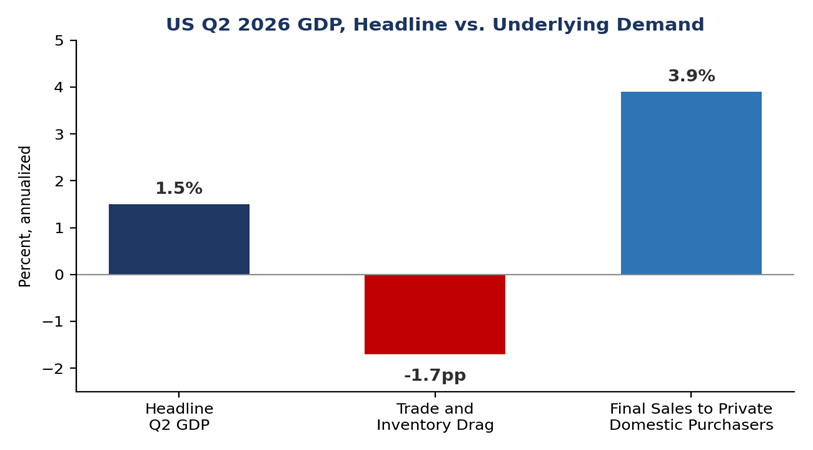
Chart built from data reported by the US Bureau of Economic Analysis
Central Banks Hold Their Ground
The U.S. Federal Reserve left its benchmark interest rate unchanged at 3.50%–3.75% at its July meeting, as policymakers continued to balance resilient economic growth against inflation that remains above the central bank’s 2% target. While the decision itself was widely expected, the meeting was notable for an unusually hawkish split, with three voting members dissenting in favor of an immediate 0.25% rate increase—highlighting that concerns over persistent inflation have not fully subsided. At the same time, the Fed acknowledged that productivity, capital investment, and labour market conditions remain supportive of continued economic expansion despite ongoing geopolitical and trade-related uncertainty. For investors, the meeting reinforced a familiar theme: monetary policy is likely to remain data dependent, with the path of interest rates hinging on incoming inflation and employment data rather than a predetermined course. Although the prospect of near-term rate cuts has diminished, the underlying strength of the economy and corporate investment environment continues to provide a constructive backdrop for long-term investors.
The Bank of Canada held its policy rate at 2.25% on July 15, the sixth consecutive hold. It expects growth of 0.7% for 2026, improving to 1.8% in both 2027 and 2028 as slack in the economy is gradually absorbed. On inflation, the Bank expects price growth to ease to about 2.5% in the second half of this year before reaching its 2% target by early 2027, a path that depends heavily on oil prices, given the ongoing conflict in the Middle East.
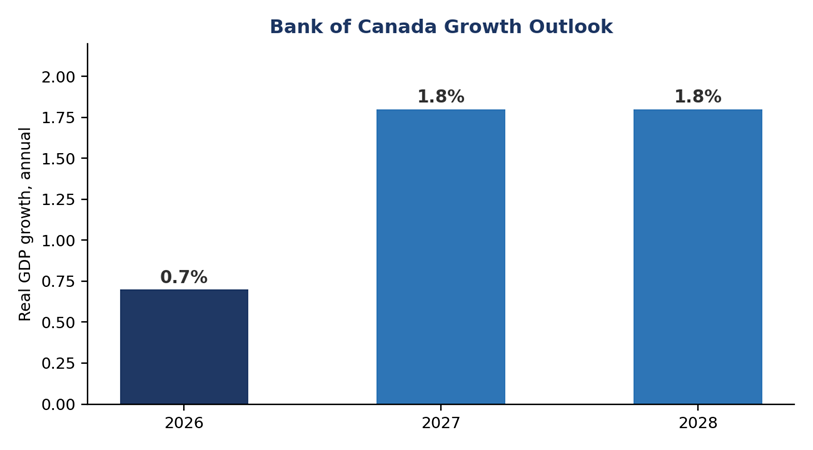
Chart built from data reported by the Bank of Canada, July 2026 Monetary Policy Report
The Federal Reserve also held steady on July 29, keeping its benchmark rate at 3.50% to 3.75%. The vote was not unanimous, three regional Fed presidents dissented in favor of a rate hike, citing inflation that has stayed above target for an extended period. Chair Kevin Warsh acknowledged the economy is showing real resilience, pointing to solid productivity and continued AI investment even as the committee stays cautious. (Sources: Federal Reserve, Bank of Canada)
Earnings Deliver, Margins Hit a Record
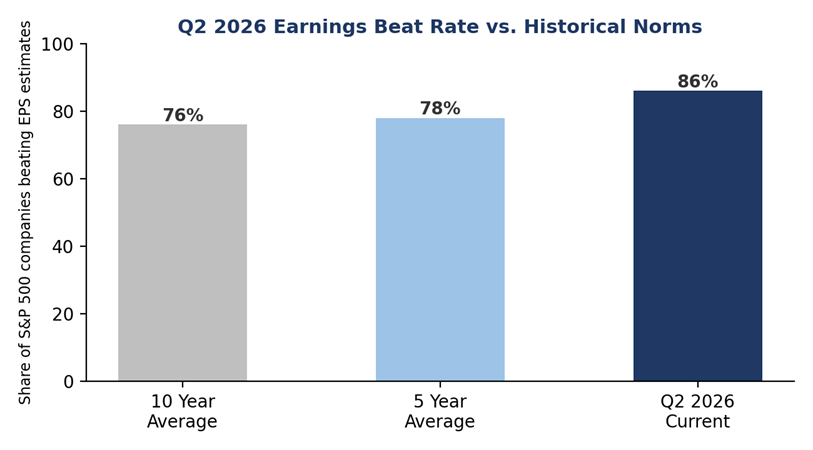
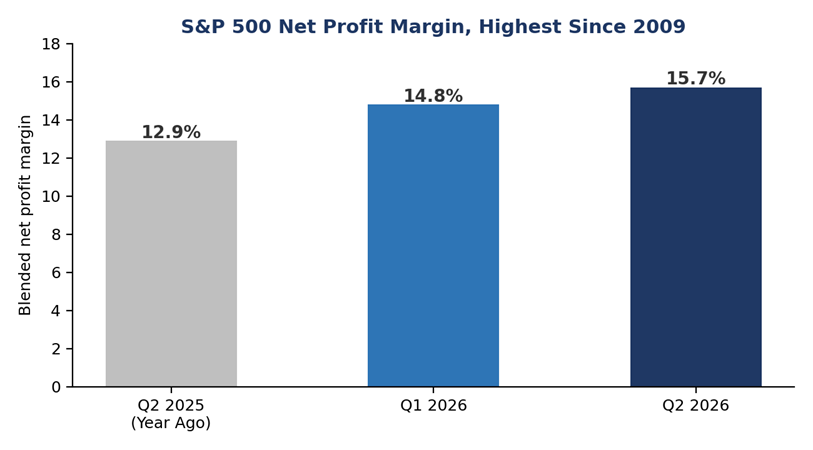
If the economic data left room for doubt, corporate earnings did not. With most of the S&P 500 having reported second quarter results, the index’s blended net profit margin reached 15.7%, the highest level since FactSet began tracking the metric in 2009, up from 14.8% in the first quarter and 12.9% a year ago. Of companies reporting so far, 86% have topped earnings expectations, well above the 78% five-year average and 76% ten-year average.
A large share of that margin strength is coming from one company. Alphabet posted a nearly 300% year over year jump in net income, aided heavily by unrealized gains on its equity stakes. Exclude Alphabet and the blended margin falls to 14.4% from 15.7%, with earnings growth falling to 25.9% from a headline 37.9%. The underlying message still holds, corporate profitability is genuinely strong even without one outsized contributor.
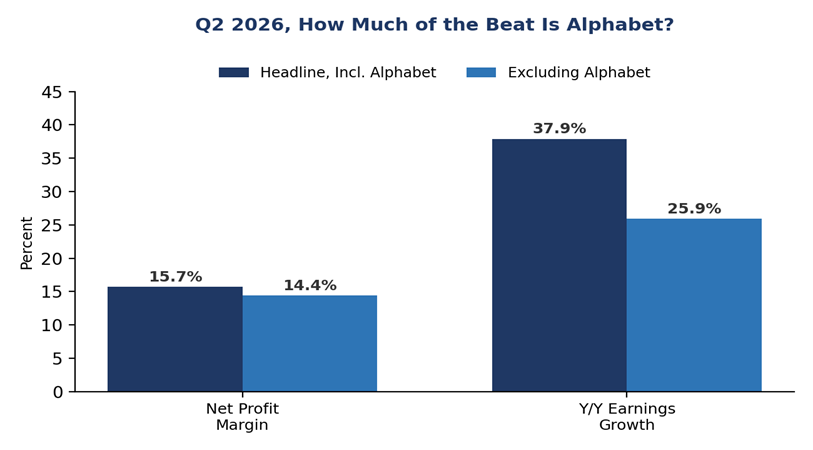
Charts built from data reported by FactSet
AI Spending Continues to Deliver
Carson Group has usefully framed the broader AI spending boom as a contest between the receivers of capital, chipmakers such as Nvidia, Broadcom, AMD, and Micron, and the spenders of capital, hyperscalers including Microsoft, Amazon, Alphabet, and Meta. For the first several years of this cycle the two groups moved together. More recently that relationship has broken down, with chipmakers continuing to climb while hyperscaler shares have lagged, a sign that investors want clearer proof the spending is paying off before rewarding the spenders as much as the suppliers. (Sources: Moonshot AI coverage via multiple outlets, Carson Group)
The recent earnings reports from Amazon, Microsoft, and Meta provided some of the strongest evidence yet that the AI investment cycle remains firmly intact. All three companies delivered robust revenue growth, healthy earnings, and, perhaps most importantly, reaffirmed that they intend to continue investing aggressively in AI infrastructure. Rather than pulling back on capital spending, management teams signaled that demand continues to exceed available capacity, reinforcing the view that AI remains one of the highest-return investment opportunities available to these businesses.
The returns on those investments are becoming increasingly visible. Amazon reported its fastest AWS growth in more than four years, supported by accelerating demand for AI services and custom chips. Microsoft saw Azure revenue grow 43%, surpassing US$100 billion in annual revenue for the first time, while adoption of Microsoft 365 Copilot continued to accelerate across enterprise customers. Meta delivered another quarter of exceptional advertising growth, driven by AI improvements that increased user engagement and advertising conversions, demonstrating that AI is no longer just a future opportunity but is already enhancing the profitability of its core business.
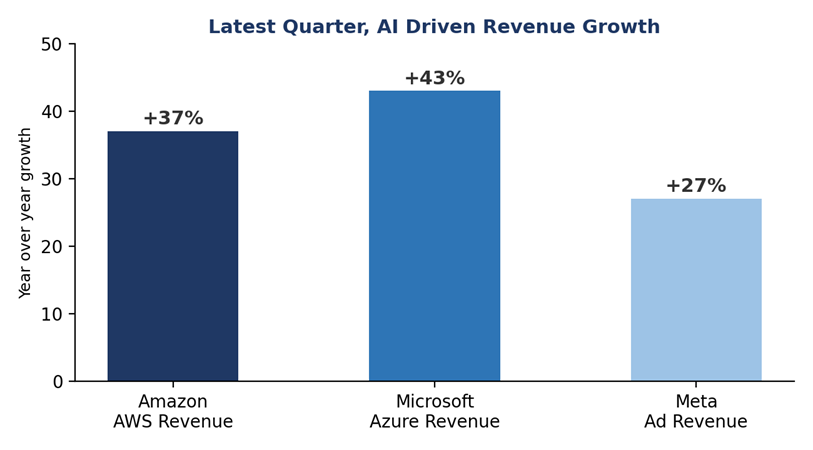
Chart built from data reported by Amazon, Microsoft, and Meta Q2 and fiscal Q4 2026 earnings releases
Despite concerns earlier this year that AI spending might begin to slow, the opposite appears to be occurring. Amazon increased its 2026 capital expenditure outlook to approximately US$220 billion, Microsoft continues to invest roughly US$175 billion, and Meta raised the lower end of its capital spending range to US$130–145 billion. Combined with analyst expectations for even higher investment in 2027, the industry’s commitment to expanding AI infrastructure remains as strong as ever. In fact, for 2027, Citigroup projects Amazon capital spending near $288 billion and Meta near $205 billion, while BNP Paribas projects Microsoft spending around $262 billion in its 2027 fiscal year. None of these are company guidance, they are analyst estimates and should be read as such, but the direction is unmistakable.
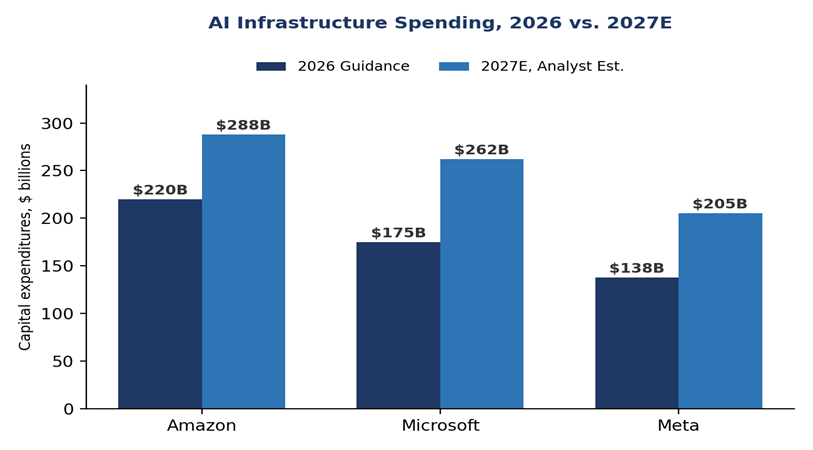
Chart built from company 2026 guidance and 2027 analyst estimates from Citigroup and BNP Paribas
While the pace at which companies monetize these investments will vary, the overall direction is becoming increasingly clear. Revenue growth is accelerating, AI-enabled products are gaining widespread customer adoption, and management teams continue to allocate record amounts of capital because they are seeing tangible returns. For long-term investors, these results reinforce our view that AI is evolving from a promising technology into a durable earnings and productivity driver across the world’s largest technology companies.
Looking Ahead
Financial markets rarely move in straight lines. Periods of heightened volatility can create the impression that uncertainty itself has become the story. In reality, volatility is often nothing more than the market’s process of reconciling expectations with evidence. July offered several examples of that process in action.
Headline GDP appeared softer than expected, yet the underlying drivers of growth strengthened meaningfully. Consumer spending accelerated, business investment remained robust, and corporate profitability reached record levels. At the same time, the companies making the largest investments in artificial intelligence began demonstrating that those investments are increasingly translating into tangible revenue growth and real economic value.
None of this suggests that risks have disappeared. Competition remains intense, margins remain under pressure for some companies, and the investment cycle is still evolving. But for the first time in several quarters, the discussion shifted meaningfully from what AI might become to what AI is already delivering.
Our investment philosophy has always been rooted in evidence rather than emotion. Headlines can influence markets in the short run, but over time it is earnings, cash flows, innovation, and economic fundamentals that determine investment outcomes. This month reinforced that distinction. As always, our ADAPT Investment Strategy remains focused on preserving capital, identifying attractive opportunities as they emerge, and maintaining portfolios that are positioned to participate in long-term growth while managing risk thoughtfully along the way.
Thank you for your continued trust. We appreciate the opportunity to help guide you through changing markets and look forward to speaking with you soon.
This information has been prepared by Kian Ghanei, a Senior Portfolio Managers for iA Private Wealth Inc. and does not necessarily reflect the opinion of iA Private Wealth. The information contained in this newsletter comes from sources we believe reliable, but we cannot guarantee its accuracy or reliability. The opinions expressed are based on an analysis and interpretation dating from the date of publication and are subject to change without notice. Furthermore, they do not constitute an offer or solicitation to buy or sell any of the securities mentioned. The information contained herein may not apply to all types of investors. The [Investment Advisor/Portfolio Manager] can open accounts only in the provinces in which they are registered.
iA Private Wealth Inc. is a member of the Canadian Investor Protection Fund and the Investment Industry Regulatory Organization of Canada. iA Private Wealth is a trademark and business name under which iA Private Wealth Inc. operates.